

Turbidity Sensor with ESP32
Water quality is one of the most important factors in drinking water, aquaculture, industries, and environmental monitoring. A Turbidity Sensor with ESP32 helps measure how clear or cloudy water is by detecting suspended particles. When combined with an ESP32, the Turbidity Sensor with ESP32 can easily monitor water quality in real time and upload data to IoT dashboards. Using a Turbidity Sensor with ESP32 enhances the accuracy of monitoring.
Utilizing a Turbidity Sensor with ESP32 ensures that water quality data is reliable, which is essential for both personal and professional applications.
In this guide, you’ll learn the working principle, pin configuration, ESP32 interfacing, Arduino code, calibration, applications, and innovative project ideas.
By integrating a Turbidity Sensor with ESP32, users can achieve significant improvements in monitoring water quality and take actionable steps to preserve aquatic environments.
By utilizing a Turbidity Sensor with ESP32, users can effectively track fluctuations in water quality, making it indispensable for both environmental and industrial applications.
Understanding how a Turbidity Sensor with ESP32 works is crucial for effective implementation in projects.
What is a Turbidity Sensor?
A Turbidity Sensor measures the cloudiness or haziness of water. The cloudiness occurs because of suspended particles like:
- Mud
- Sand
- Dust
- Organic waste
- Microorganisms
- Algae
The sensor measures turbidity in NTU (Nephelometric Turbidity Units).
Water Quality Reference
| Water Condition | NTU Value |
|---|---|
| Crystal Clear Water | 0–5 NTU |
| Drinking Water | Below 5 NTU |
| Slightly Dirty Water | 5–50 NTU |
| Cloudy Water | 50–500 NTU |
| Very Dirty Water | Above 500 NTU |
How Does a Turbidity Sensor Work?
The turbidity sensor contains:
The Turbidity Sensor with ESP32 also provides valuable data that can help in environmental research.
- Infrared LED (IR Transmitter)
- Infrared Photodiode (Receiver)
Working Principle
- The IR LED emits infrared light.
- Light passes through the water sample.
- Suspended particles scatter the light.
- The photodiode detects the amount of received light.
- The sensor converts this into an analog voltage.
- The ESP32 reads this voltage and calculates the turbidity value.
Higher turbidity means less light reaches the receiver.
Understanding how a Turbidity Sensor with ESP32 functions allows for better data interpretation and utilization in various projects.
Turbidity Sensor Pinout
Most analog turbidity sensor modules provide four pins.
| Pin | Description |
|---|---|
| VCC | 5V Power Supply |
| GND | Ground |
| AO | Analog Output |
| DO | Digital Output (Threshold Detection) |
For accurate NTU measurement, use the Analog Output (AO).
The readings from the Turbidity Sensor with ESP32 can be used to inform water treatment processes.
ESP32 Connection
| Turbidity Sensor | ESP32 |
|---|---|
| VCC | 3.3V or 5V (according to module specification) |
| GND | GND |
| AO | GPIO34 |
| DO | Optional GPIO |
GPIO34 is an input-only ADC pin, making it ideal for analog sensors.
Utilizing a Turbidity Sensor with ESP32 enables proactive measures to be taken in water quality management.
For best results, calibrate your Turbidity Sensor with ESP32 according to manufacturer guidelines.
ESP32 Arduino Code
Incorporating a Turbidity Sensor with ESP32 into your projects will enhance their data collection capabilities.
#define TURBIDITY_PIN 34

void setup() {
  Serial.begin(115200);
}

void loop() {

  int adc = analogRead(TURBIDITY_PIN);
  float voltage = adc * (3.3 / 4095.0);

  float ntu;

  if (voltage < 2.5) {
    ntu = 3000;
  } else {
    ntu = -1120.4 * voltage * voltage + 5742.3 * voltage - 4352.9;
  }

  if (ntu < 0)
    ntu = 0;

  Serial.print("Voltage: ");
  Serial.print(voltage, 3);
  Serial.print(" V");

  Serial.print("  Turbidity: ");
  Serial.print(ntu);
  Serial.println(" NTU");

  delay(1000);
}
Circuit Diagram
Make sure to connect the Turbidity Sensor with ESP32 properly for accurate readings.
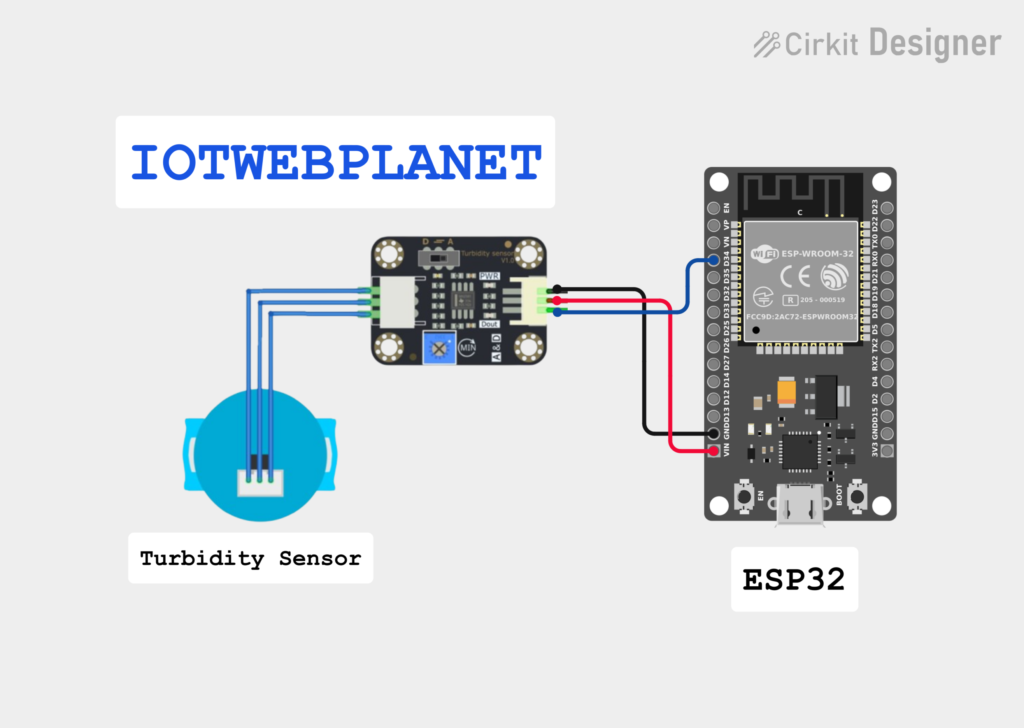
The Turbidity Sensor with ESP32 is often used in combination with other sensors to provide a comprehensive overview of water quality.
The Turbidity Sensor with ESP32 can be crucial for smart water management in agriculture.
Code Explanation
Reading ADC
int adc = analogRead(TURBIDITY_PIN);
Reads the analog value from GPIO34.
Convert ADC to Voltage
float voltage = adc * (3.3 / 4095.0);
ESP32 has a 12-bit ADC.
- Minimum = 0
- Maximum = 4095
- Reference Voltage = 3.3V
Many industries have started adopting the Turbidity Sensor with ESP32 for effective water management solutions.
Calculate NTU
ntu = -1120.4 * voltage * voltage + 5742.3 * voltage - 4352.9;
The integration of a Turbidity Sensor with ESP32 into various systems can demonstrate the importance of monitoring water parameters accurately.
This polynomial converts voltage into an estimated NTU value.
Remove Negative Values
if(ntu<0)
    ntu=0;
NTU cannot be negative.
Display Output
The Serial Monitor displays:
Voltage: 2.87 V
Turbidity: 42 NTU
Calibration
Every turbidity sensor differs slightly.
For accurate measurements:
- Test with clean water.
- Test with muddy water.
- Compare readings with a standard turbidity meter.
- Adjust the polynomial equation if required.
Understanding the importance of a Turbidity Sensor with ESP32 can lead to better water quality solutions.
Advantages
- Low cost
- Easy to interface
- Fast response
- Low power consumption
- Suitable for IoT
- Good for educational projects
Disadvantages
- Needs calibration
- Sensitive to air bubbles
- Sensor surface should remain clean
- Accuracy depends on water temperature and lighting
Applications
A turbidity sensor is widely used in:
- Water treatment plants
- Drinking water quality monitoring
- River pollution monitoring
- Smart cities
- Fish farming (Aquaculture)
- Swimming pools
- Wastewater treatment
- Industrial water systems
- Environmental research
- Agriculture irrigation systems
Utilizing a Turbidity Sensor with ESP32 can provide insights that support environmental sustainability efforts.
Best IoT Projects Using Turbidity Sensor
1. Smart Water Quality Monitoring System
Monitor:
- Turbidity
- pH
- TDS
- Temperature
Upload data to a cloud dashboard.
2. IoT Environmental Monitoring Station
Testing with a Turbidity Sensor with ESP32 alongside other technologies can yield invaluable insights for environmental monitoring.
Combine multiple sensors:
- pH Sensor
- Turbidity Sensor
- TDS Sensor
- DHT11
- GPS
- GSM
- ESP32
Send alerts to a mobile app or cloud dashboard.
Frequently Asked Questions (FAQs)
What does a turbidity sensor measure?
It measures the cloudiness or suspended particles in water.
What is NTU?
NTU stands for Nephelometric Turbidity Units, the standard unit used to measure water turbidity.
Deployment of a Turbidity Sensor with ESP32 in different environments can showcase its versatility.
Utilizing a Turbidity Sensor with ESP32 facilitates advancements in smart city initiatives focused on water quality.
Which ESP32 pin should I use?
GPIO34 is recommended because it supports analog input.
Can I use the digital output?
Yes, but it only provides HIGH/LOW detection based on a threshold. Use the analog output for actual NTU measurement.
Can this sensor detect drinking water quality?
It measures turbidity only. For complete water quality analysis, combine it with pH, TDS, temperature, and dissolved oxygen sensors.
Keep in mind that a Turbidity Sensor with ESP32 will require maintenance for optimal performance.
With the Turbidity Sensor with ESP32, users gain insights into water clarity dynamics.
Choosing the right Turbidity Sensor with ESP32 can greatly enhance data reliability.
Conclusion
Continuous monitoring with a Turbidity Sensor with ESP32 aids in better decision-making in water management.
The integration of a Turbidity Sensor with ESP32 can enable smart water management.
The Turbidity Sensor with ESP32 is an affordable and practical solution for monitoring water clarity. When paired with an ESP32, it becomes the foundation of smart IoT water quality systems capable of real-time monitoring, cloud connectivity, and automated alerts. Whether you’re building a school project, industrial monitoring system, or environmental research platform, this sensor is an excellent starting point for projects utilizing the Turbidity .



Leave a Reply
You must be logged in to post a comment.