

ESP32 Joystick Controlled Robot Using ESP-NOW Protocol & L298N Motor Driver
- 2025
🤖 ESP32 Joystick Controlled Robot Using ESP-NOW Protocol & L298N Motor Driver
Wireless bot control with speed adjustment via joystick tilt
📝 Introduction
In this project, we built a wireless robot controlled via a joystick and two ESP32 boards using the ESP-NOW communication protocol. Unlike Wi-Fi or Bluetooth, ESP-NOW enables fast, peer-to-peer data transfer between ESP32 devices using MAC addresses, making it ideal for real-time robot control.
The robot’s movement and speed are controlled through analog joystick input, and an L298N motor driver handles motor driving on the receiving end.
🔧 Hardware Used
| Component | Description |
|---|---|
| 2x ESP32 | One for sending joystick data, one for receiving and controlling motors |
| Joystick Module | Outputs analog X/Y values |
| L298N Motor Driver | Dual H-Bridge to drive DC motors |
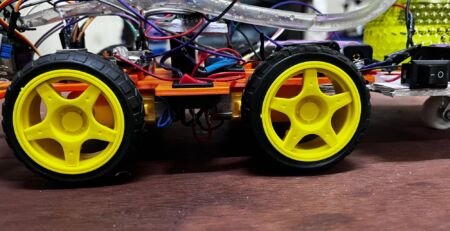
| Robot Chassis | With 2x DC motors |
| Jumper Wires + Power | Batteries or USB |
🧠 How It Works
➤ Communication Setup
- The sender ESP32 reads the X and Y analog values from a joystick.
- These values are sent via ESP-NOW protocol to the receiver ESP32.
- The receiver ESP32 processes the data and controls the L298N motor driver using the L298NX2 library.
- Speed is adjusted based on how far the joystick is pushed.
➤ Direction Mapping
- Y-axis forward → robot forward
- Y-axis backward → robot reverse
- X-axis left/right → turn accordingly
- Small movements result in low speed; full push gives max speed.
📡 Setting Up ESP-NOW Communication
To communicate using ESP-NOW, both ESP32 boards need to:
- Be in WiFi Station mode
- Share the receiver’s MAC address
- Be added as peers in the ESP-NOW network
Use this code on the receiver ESP32 to get its MAC ad
🛠️ Wiring Summary
Sender (Joystick to ESP32)
| Joystick Pin | ESP32 Pin |
|---|---|
| VRx | GPIO 34 |
| VRy | GPIO 35 |
| GND | GND |
| VCC | 3.3V |
Receiver (ESP32 to L298N)
| L298N Pin | ESP32 Pin |
|---|---|
| IN1 | 18 |
| IN2 | 19 |
| IN3 | 16 |
| IN4 | 17 |
| ENA | 4 (PWM) |
| ENB | 5 (PWM) |
🎥 Demo Output
- Forward push: robot moves ahead
- Full tilt → max speed
- Side push: turns left or right
- Release joystick → bot stops
Tested delay: ~50ms for excellent real-time response
Use this code on the receiver ESP32 to get its MAC ad
/*
Rui Santos & Sara Santos – Random Nerd Tutorials
Complete project details at https://RandomNerdTutorials.com/get-change-esp32-esp8266-mac-address-arduino/
Permission is hereby granted, free of charge, to any person obtaining a copy of this software and associated documentation files.
The above copyright notice and this permission notice shall be included in all copies or substantial portions of the Software.
#include <WiFi.h>
#include <esp_wifi.h>

void readMacAddress(){
  uint8_t baseMac[6];
  esp_err_t ret = esp_wifi_get_mac(WIFI_IF_STA, baseMac);
  if (ret == ESP_OK) {
    Serial.printf("%02x:%02x:%02x:%02x:%02x:%02x\n",
                  baseMac[0], baseMac[1], baseMac[2],
                  baseMac[3], baseMac[4], baseMac[5]);
  } else {
    Serial.println("Failed to read MAC address");
  }
}

void setup(){
  Serial.begin(115200);

  WiFi.mode(WIFI_STA);
  WiFi.STA.begin();

  Serial.print("[DEFAULT] ESP32 Board MAC Address: ");
  readMacAddress();
}

void loop(){

}
Sender Code (Joystick to ESP32)
#include <esp_now.h>
#include <WiFi.h>

const int xPin = 34;         // VRx
const int yPin = 35;         // VRy
const int buttonPin = 14;    // SW
#define LED 2

uint8_t broadcastAddress[] = {0x30, 0xC6, 0xF7, 0x22, 0xEB, 0xD8};

typedef struct struct_message {
  char a[32];
  int x, y;
  bool button;
} struct_message;

struct_message myData;
esp_now_peer_info_t peerInfo;

bool isConnected = false;
unsigned long lastSendTime = 0;
unsigned long timeoutDuration = 2000; // 2 seconds timeout

void OnDataSent(const uint8_t *mac_addr, esp_now_send_status_t status) {
  if (status == ESP_NOW_SEND_SUCCESS) {
    isConnected = true;
    lastSendTime = millis(); // reset timeout
    Serial.println("✅ Delivery Success");
  } else {
    Serial.println("❌ Delivery Fail");
  }
}

void setup() {
  Serial.begin(115200);
  pinMode(buttonPin, INPUT_PULLUP);
  pinMode(LED, OUTPUT);

  WiFi.mode(WIFI_STA);

  if (esp_now_init() != ESP_OK) {
    Serial.println("Error initializing ESP-NOW");
    return;
  }

  esp_now_register_send_cb(OnDataSent);

  memcpy(peerInfo.peer_addr, broadcastAddress, 6);
  peerInfo.channel = 0;
  peerInfo.encrypt = false;

  if (esp_now_add_peer(&peerInfo) != ESP_OK) {
    Serial.println("Failed to add peer");
    return;
  }
}

void loop() {
  int xValue = analogRead(xPin);
  int yValue = analogRead(yPin);
  bool buttonPressed = digitalRead(buttonPin) == LOW;

  int mappedX = map(xValue, 0, 4095, 0, 100);
  int mappedY = map(yValue, 0, 4095, 0, 100);

  myData.x = mappedX;
  myData.y = mappedY;
  myData.button = buttonPressed;
  strcpy(myData.a, "Joystick Data");

  esp_err_t result = esp_now_send(broadcastAddress, (uint8_t *) &myData, sizeof(myData));

  if (result == ESP_OK) {
    Serial.printf("📤 Sent: X=%d, Y=%d, Btn=%s\n", mappedX, mappedY, buttonPressed ? "Pressed" : "Released");
  } else {
    Serial.println("🚫 Error sending the data");
  }

  // ⚠️ Simulate connection timeout (if no successful sends recently)
  if (millis() - lastSendTime > timeoutDuration) {
    isConnected = false;
  }

  digitalWrite(LED, isConnected ? HIGH : LOW);

  delay(200);
}
Receiver Code (Joystick to ESP32)
#include <L298NX2.h>
#include <esp_now.h>
#include <WiFi.h>

// Motor pins
#define ENA 4
#define IN_1 16
#define IN_2 17
#define ENB 5
#define IN_3 18
#define IN_4 19

#define LED 2
#define TIMEOUT 5000

L298NX2 mybot(ENA, IN_1, IN_2, ENB, IN_3, IN_4);

typedef struct struct_message {
  char a[32];
  int x, y;
  bool button;
} struct_message;

struct_message myData;
unsigned long lastRecvTime = 0;

void OnDataRecv(const uint8_t * mac, const uint8_t *incomingData, int len) {
  memcpy(&myData, incomingData, sizeof(myData));

  Serial.print("Message: "); Serial.println(myData.a);
  Serial.print("Xaxis: "); Serial.println(myData.x);
  Serial.print("Yaxis: "); Serial.println(myData.y);
  Serial.print("Button: "); Serial.println(myData.button ? "Pressed" : "Released");
  Serial.println();

  digitalWrite(LED, HIGH);
  lastRecvTime = millis();

  // Basic Joystick-based Movement
  if (myData.y == 0 && myData.x!=0) {
    mybot.forward();
    Serial.println("Forward");
  }
  else if (myData.y==100 &&  myData.x!=100) {
    mybot.backward();
    Serial.println("Backward");
  }
  else if (myData.x==0 && myData.y!=0) {
    mybot.forwardA();
    mybot.backwardB();
    Serial.println("Left");
  }
  else if (myData.x==100 && myData.y!=100) {
    mybot.forwardB();
    mybot.backwardA();
    Serial.println("Right");
  }
  else {
    mybot.stop();
    Serial.println("Stop");
  }
}

void setup() {
  Serial.begin(115200);
  pinMode(LED, OUTPUT);
  digitalWrite(LED, LOW);

  WiFi.mode(WIFI_STA);

  if (esp_now_init() != ESP_OK) {
    Serial.println("Error initializing ESP-NOW");
    return;
  }

  esp_now_register_recv_cb(esp_now_recv_cb_t(OnDataRecv));

  mybot.setSpeed(100);
  mybot.stop(); // Ensure motors are off on start
}

void loop() {
  if (millis() - lastRecvTime > TIMEOUT) {
    digitalWrite(LED, LOW);
    mybot.stop(); // stop bot if no data received
  }
}



Leave a Reply
You must be logged in to post a comment.