

12Dec
ESP32 with ADXL335 Accelerometer
- 11-06-2025
The ADXL335 is a small, thin, low-power 3-axis analog accelerometer manufactured by Analog Devices. It is widely used in embedded systems and electronics projects for sensing acceleration in the X, Y, and Z directions.
🔧 Key Features of ADXL335
| Feature | Description |
|---|---|
| Type | Analog 3-axis accelerometer |
| Measurement Range | ±3 g (g = gravity, approx. 9.81 m/s²) |
| Power Supply | 1.8V to 3.6V |
| Output Type | Analog voltage |
| Sensitivity | ~300 mV/g (at 3V supply) |
| Low Power | ~350 µA typical |
| Operating Temp | -40°C to +85°C |
| Bandwidth | Adjustable via external capacitors |
📊 How It Works
- The ADXL335 uses a micro-machined structure suspended by springs inside a silicon chip.
- As the device accelerates, the structure deflects, changing the capacitance between fixed plates.
- This change is converted into an analog voltage signal on each of the X, Y, and Z output pins.
📈 Typical Output
Each axis outputs a voltage that is approximately:
- 0V to Vcc (depending on acceleration)
- At 0g, each axis outputs about Vcc/2
- E.g., for 3.3V Vcc, 0g = ~1.65V
- ±1g will cause an increase or decrease of about 300 mV from the 0g level.
⚙️ Applications
- Tilt sensing
- Motion and vibration detection
- Gaming and user interface devices
- Wearables
- Robotics and drones
- Automotive crash detection or car alarms
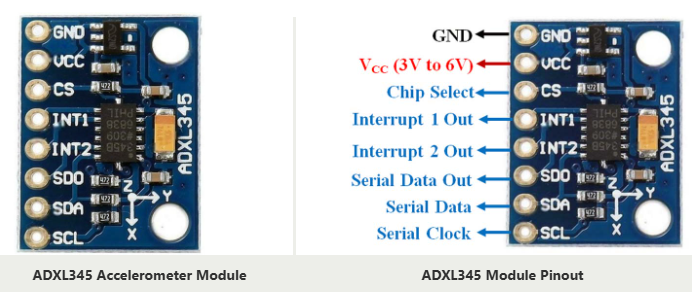
🔌 Connecting ADXL335 to a Microcontroller (e.g., Arduino)
| ADXL335 Pin | Arduino |
|---|---|
| VCC | 3.3V |
| GND | GND |
| X OUT | A0 |
| Y OUT | A1 |
| Z OUT | A2 |
📌 Summary
- The ADXL335 is a simple, reliable, analog accelerometer.
- Ideal for detecting orientation and motion in low-power embedded systems.
- Requires an ADC (Analog-to-Digital Converter) to read data (like in Arduino).
- Easy to use, but needs calibration for precise results.
HOW TO OPERATE


Leave a Reply
You must be logged in to post a comment.